
Executive Summary
This report provides a comprehensive, practice-oriented guide for international importers sourcing servers and data processing equipment from China. As the world’s largest electronics manufacturing base, China produces the majority of global server hardware through both branded vendors (Lenovo, Inspur, Huawei) and Taiwanese-headquartered ODMs (Foxconn, Quanta, Wistron, Wiwynn) operating mainland factories. This guide covers market landscape, white-box vs. branded sourcing strategies, pricing benchmarks, compliance requirements, logistics for heavy IT equipment, quality control frameworks, and risk mitigation — all structured for immediate procurement execution.
Key Takeaways for Importers:
- Two sourcing models: Branded servers (Lenovo, HPE, Dell) with full support/warranty at premium pricing; White-box / ODM direct (Foxconn, Quanta, Inspur) at 20–35% lower cost with customizable configurations.
- Typical 2U rack server FOB pricing: ODM barebone $600–$1,200; fully configured entry $1,200–$1,800; branded enterprise $2,500–$4,000+.
- MOQ varies dramatically: 1–2 units for resold brand servers; 50–100 units for semi-custom white-box; 500+ units for full ODM custom design.
- AI/GPU servers may be subject to export control restrictions (US EAR rules, China dual-use regulations) — verify licensing before ordering.
- Quality control must include 48–72 hour burn-in / stress testing — server reliability is mission-critical and post-shipment failures are extremely costly.
1. Market Overview & China’s Position in Global Server Manufacturing
1.1 Global Server Market Context
China is the world’s dominant server manufacturing hub. Taiwanese Original Design Manufacturers (ODMs) — Foxconn (Hon Hai), Quanta Computer, Wistron, Wiwynn, Inventec, and Mitac — produce approximately 70% of the world’s servers, with the majority of assembly capacity located in mainland China (Suzhou, Kunshan, Chongqing, Shenzhen). Domestic Chinese brands including Inspur, Lenovo, Huawei, and H3C serve both the China domestic market and international customers.
1.2 China Domestic Server Market Share (2025–2026)
According to IDC and industry reports, the China domestic server market is led by:
| Vendor | Market Share | Notes |
|---|---|---|
| Inspur (浪潮) | ~21% | #1 in China; strong in GPU/AI servers; also sells internationally |
| Quanta Computer (广达) | ~15% | Largest ODM; supplies hyperscalers (Meta, Google, etc.) |
| Foxconn (富士康) | ~12% | #2 ODM; Microsoft, Nvidia GB200 server cabinets |
| Wistron (纬创) | ~9% | Major ODM; expanding to Mexico for US-bound production |
| Lenovo (联想) | ~8–10% | Global #3 by revenue; enterprise and SMB focus |
| Huawei (华为) | ~7–9% | Fast-growing; Kunpeng ARM servers + x86; strong domestic government/telecom |
| H3C (新华三) | ~5–7% | Enterprise networking + servers; Tsinghua Unigroup / HPE joint venture heritage |
| Dell / HPE | ~10–12% combined | Multinational enterprise segment; manufactured in China but facing localization headwinds |
| Others | ~15–20% | Wiwynn, Inventec, Supermicro contract mfg, regional brands |
1.3 White-Box vs. Branded Servers: Strategic Choice
The most important sourcing decision is whether to buy branded servers or go direct to ODMs for white-box (unbranded) hardware.
| Factor | Branded Servers (Lenovo, Dell, HPE) | White-Box / ODM Direct |
|---|---|---|
| Cost | Premium pricing ($2,500–$4,000+ for mid-range 2U) | 20–35% lower ($1,200–$1,800 equivalent config) |
| Customization | Limited to pre-defined SKUs; minor config changes | Full hardware customization: chassis design, port layout, BIOS, branding |
| Warranty & Support | Global 24/7 support, 3–5 year warranty, spare parts network | Factory warranty only (1–3 years); support quality varies by ODM |
| Firmware / Software | Proprietary management software (iDRAC, iLO, XClarity) | Standard IPMI/Redfish; may require custom integration |
| MOQ | 1 unit (distributor channel) | 50–500+ units depending on customization level |
| Certifications | Full global certifications pre-obtained | May need to obtain/transfer certifications for your target market |
| Best For | Enterprise end-customers, small orders, mission-critical deployments | Data center operators, ISPs, resellers with in-house tech capability, high-volume deployments |
2. Major Manufacturing Clusters in China
Server manufacturing in China is concentrated in four major clusters, each with different specialization and access profiles. Understanding these clusters helps target the right suppliers for your volume and product type.
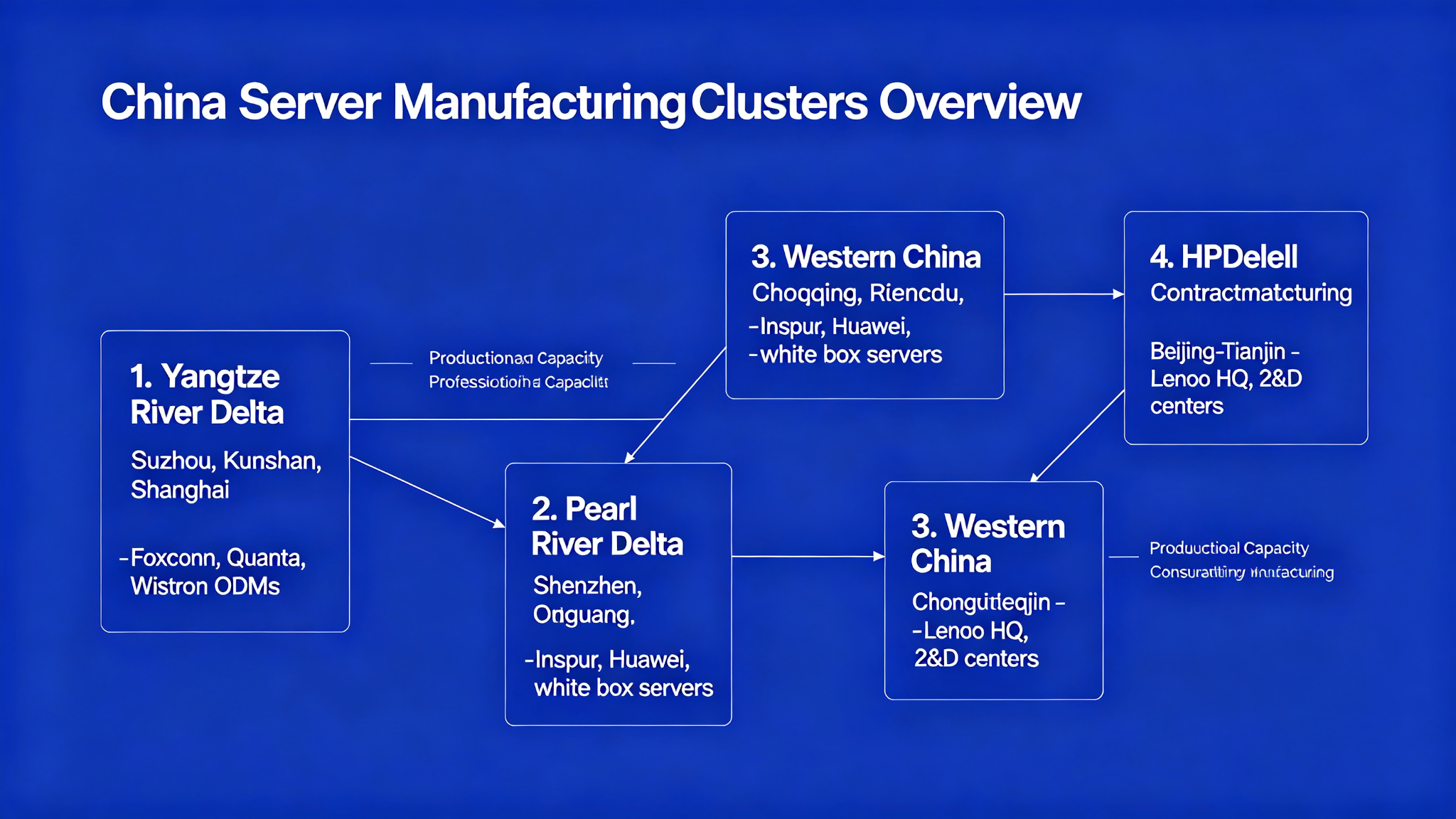
2.1 Yangtze River Delta (Suzhou, Kunshan, Shanghai)
Core Cities: Suzhou Industrial Park, Kunshan, Shanghai, Wuxi
Specialization: Tier-1 ODM server manufacturing, high-density rack servers, AI/GPU servers, enterprise-grade systems
Key Players: Foxconn, Quanta Computer, Wistron, Wiwynn, Inventec — all operating major production campuses
Strengths: Highest quality and automation standards, complete supply chain ecosystem, proximity to Shanghai port, skilled engineering workforce, strong PCB and component supplier base
Considerations: Highest production costs in China; MOQs are typically high (500+ units for custom builds); primarily serves hyperscale and large enterprise clients — difficult for small-to-medium importers to access directly
Industry Note: Suzhou has emerged as the global AI server manufacturing hub, producing the majority of Nvidia H100/H200-based server systems for global cloud providers.
2.2 Pearl River Delta (Shenzhen, Dongguan, Guangzhou)
Core Cities: Shenzhen (Longgang, Bao’an, Guangming), Dongguan, Huizhou
Specialization: White-box servers, storage servers, edge computing, mid-range rack servers, server chassis and components
Key Players: Inspur (Shenzhen HQ and manufacturing), Huawei (Dongguan/Shenzhen), numerous mid-tier white-box ODMs, chassis manufacturers
Strengths: More accessible for medium-volume orders (50–500 units), flexible customization, strong component sourcing ecosystem (Huaqiangbei), proximity to Hong Kong for logistics, faster turnaround for custom projects
Considerations: Quality varies significantly between factories. Rigorous vetting essential. Many smaller “server manufacturers” are actually assemblers rather than true ODMs.
2.3 Western China (Chongqing, Chengdu)
Core Cities: Chongqing Liangjiang New Area, Chengdu Hi-Tech Zone
Specialization: High-volume mass production for major brands, notebook and server mixed manufacturing
Key Players: Foxconn Chongqing, HP/Quanta Chongqing facilities, Dell Chengdu, Lenovo Chengdu
Strengths: Lower labor and land costs, government incentives for inland manufacturing, growing rail connectivity to Europe (Chengdu-Europe express)
Considerations: Primarily dedicated production lines for major brand contracts. Very difficult for independent importers to access direct manufacturing. More relevant for component sourcing and secondary supply chain.
2.4 Beijing-Tianjin Region
Core Cities: Beijing, Tianjin, Langfang
Specialization: R&D headquarters, domestic brand operations, government and enterprise sales
Key Players: Lenovo global HQ, Baidu AI cloud infrastructure, Tsinghua Unigroup / H3C
Strengths: Access to senior decision-makers at major Chinese server vendors; government and enterprise channel expertise
Considerations: More commercial/channel hub than manufacturing cluster. Production is typically subcontracted to Suzhou/Shenzhen factories.
2.5 Cluster Comparison Matrix for Sourcing
| Factor | Yangtze Delta | Pearl Delta | Western China | Beijing |
|---|---|---|---|---|
| Price Level | High | Medium | Low-Medium | High (channel) |
| Quality Standard | Premium (Tier-1 ODM) | Variable (mid-tier) | High (brand lines) | N/A |
| Typical MOQ | 500–5,000+ units | 50–500 units | Brand-contracted only | 1+ units (distribution) |
| Customization | Full ODM design | Semi-custom / configure-to-order | Brand SKUs only | Brand SKUs only |
| Best For | Hyperscale, large enterprise | Mid-market importers, ISPs | Major brand distribution | Brand channel partners |
3. Supplier Landscape: ODMs, Brands, and White-Box Vendors
3.1 Tier-1 ODMs (Taiwanese EMS Giants)
These are the world’s largest server designers and contract manufacturers. They design and build for hyperscalers (AWS, Meta, Google, Microsoft) and major brands (Dell, HPE, Lenovo). Direct engagement requires very high volume.
| ODM Company | Main China Locations | Major Clients & Specialization |
|---|---|---|
| Foxconn (Hon Hai) | Suzhou, Shenzhen, Chengdu | World’s largest EMS. Microsoft, Nvidia GB200 NVL72 server cabinets, Apple, Dell. Broadest server manufacturing capacity. |
| Quanta Computer | Suzhou, Shanghai, Chongqing | #1 server ODM by volume. Meta (Facebook), Google, AWS, LinkedIn. Strong in OCP (Open Compute Project) designs. |
| Wistron | Kunshan, Suzhou | Dell, Lenovo enterprise lines. Expanding Mexico production for US tariff avoidance. |
| Wiwynn | Suzhou | Spin-off from Wistron; focused exclusively on cloud service providers. Meta, Amazon AWS. |
| Inventec | Suzhou, Shanghai | HPE, enterprise and storage servers. Strong in high-density rack designs. |
| Mitac / MiTAC Computing | Suzhou | Mid-tier ODM; cloud and enterprise servers, TYAN brand. More accessible for medium volumes. |
3.2 Chinese Domestic Brand Server Vendors
These Chinese brands sell their own branded servers internationally through channel partners and direct sales. Many offer competitive pricing for standard configurations.
| Brand | Profile & International Sourcing |
|---|---|
| Inspur (浪潮信息) | China’s #1 server brand and global top-5. Strong AI/GPU server capability. Sells internationally via Inspur Systems (US/EU subsidiaries). Wide product range from 1U to 8U rack, blade, and storage servers. Note: subject to US export restrictions on certain high-end AI models. |
| Lenovo (联想) | Global #3 server vendor. ThinkSystem and ThinkAgile product lines. Full global channel network, certifications, and warranty support. Most “western-market-ready” Chinese brand. Manufacturing in China, Hungary, Mexico. |
| Huawei (华为) | FusionServer product line. Both x86 (Intel/AMD) and Kunpeng ARM-based servers. Strong in telecom and enterprise. Subject to US sanctions affecting component supply — verify availability of specific models before ordering. |
| H3C (新华三) | UniServer product line. Strong domestic enterprise presence. Part of Tsinghua Unigroup. Growing international channel in Southeast Asia, Middle East, Africa. |
| Sugon (中科曙光) | High-performance computing (HPC) and enterprise servers. Strong government and research institute background. On US Entity List — high-end models restricted. |
| Powerleader (宝德) | Mid-tier domestic brand; also does ODM for international clients. More flexible MOQ terms than top-tier brands. |
3.3 Mid-Tier White-Box / Custom ODMs (Shenzhen/Dongguan)
For importers needing 50–500 units with custom branding or specific configurations, the Shenzhen/Dongguan area hosts dozens of mid-tier server manufacturers. These are smaller than the Tier-1 ODMs but far more accessible.
- Typical capabilities: Configure-to-order rack servers (1U/2U/4U), storage servers, edge servers, mini servers
- Components: Use off-the-shelf Intel/AMD CPUs, standard memory, enterprise SSD/HDDs from major brands
- Quality range: Varies dramatically — from ISO-certified factories with proper burn-in testing to simple assembly shops
- MOQ: Typically 10–100 units for standard chassis with custom logo; 500+ for custom chassis tooling
- Certifications: Many have basic CE/FCC; verify validity and model coverage before ordering
3.4 Refurbished / Used Server Market
China has a large market for refurbished enterprise servers (Dell PowerEdge, HPE ProLiant, Lenovo ThinkSystem), primarily sourced from data center decommissions.
- Pricing: 30–60% below new equivalent configurations
- Grading: Grade A (like-new, low usage hours), Grade B (cosmetic wear, fully functional), Grade C (high hours, for parts)
- MOQ: 1 unit minimum on platforms like Alibaba
- Key Risks: Counterfeit components, worn drives, missing firmware licenses, no manufacturer warranty. Third-party inspection is essential.
- Best For: Budget-constrained deployments, non-critical workloads, parts/spare inventory
4. Sourcing Channels & Supplier Identification
4.1 Online B2B Platforms
| Platform | Best For | MOQ Range | Risk Level |
|---|---|---|---|
| Alibaba.com | Broadest supplier base; white-box servers, chassis, rack cabinets; Trade Assurance escrow | 1–500 units | Medium (verify carefully) |
| Made-in-China.com | Factory-verified listings; focus on manufacturing enterprises | 10–500 units | Medium-Low |
| Global Sources | Premium verified suppliers; higher quality threshold | 100+ units | Low |
| Brand Direct Channels | Lenovo, Inspur international sales teams; official channel partners | 1+ unit (volume pricing tiers) | Lowest |
Practical Tip for Server Sourcing: Server hardware is much more complex than consumer PCs. When evaluating suppliers on B2B platforms, ask specific technical questions: Do they perform 48-hour burn-in testing? What is the MTBF specification? Which IPMI/BMC firmware is used? Can they provide component traceability for CPUs and memory? Suppliers that cannot answer these confidently are likely simple assemblers, not serious server manufacturers.
4.2 Trade Shows & Industry Events
- CeBIT / Hannover Messe (Germany): Major European enterprise IT show — many Chinese server vendors exhibit
- Computex Taipei: The world’s premier server and computing show. All major ODMs exhibit. Best for high-volume sourcing discussions.
- China International Import Expo (CIIE, Shanghai): Domestic-focused but good for meeting Chinese vendors
- OCP Summit (Open Compute Project): Essential if sourcing white-box/OCP standard servers
4.3 Channel Partners & Distributors
For branded servers (Lenovo, Inspur, H3C), working with authorized distributors is often the most practical approach for international buyers:
- Advantages: Genuine products with valid warranties, proper export documentation, established logistics channels, credit terms for established buyers
- Disadvantages: Higher pricing than factory-direct; limited customization
- Major distributors: Ingram Micro, Tech Data, TD Synnex (global); regional distributors in Middle East, Africa, SE Asia
4.4 Direct ODM Engagement
For orders of 5,000+ units per year, you may qualify for direct ODM engagement:
- Contact ODM sales teams via their corporate websites or industry events
- Prepare detailed requirements: annual volume, target specs, certification requirements, target markets
- Expect NDA and technical qualification process
- ODM engagement typically includes NRE (Non-Recurring Engineering) fees for custom designs: $50,000–$500,000+ depending on complexity
5. Pricing Structure, BOM Cost & MOQ Requirements
5.1 Server Price Benchmarks (FOB China, 2025–2026)
Rackmount Servers
| Product Tier | Typical Configuration | FOB Unit Price | Typical MOQ |
|---|---|---|---|
| Entry 1U Rack | Single Xeon Silver / EPYC, 32GB RAM, 2× SSD, 550W PSU, no GPU | $1,200 – $1,800 (ODM white-box)$2,500 – $3,500 (branded) | 50–100 units (white-box)1 unit (branded dist.) |
| Mid-Range 2U | Dual Xeon Gold, 128–256GB RAM, 8–12× HDD/SSD, redundant PSU | $2,800 – $4,500 (white-box)$5,000 – $8,000 (branded) | 20–100 units |
| Storage Server 4U | Single/dual CPU, 24–36 drive bays, SAS expander, 10GbE | $3,500 – $6,000 (white-box)$7,000 – $12,000 (branded) | 10–50 units |
| AI / GPU Server | Dual Xeon Platinum, 4–8× GPU (A100/H100 class), 512GB+ RAM, 3kW+ PSU | $15,000 – $50,000+ (white-box)$25,000 – $80,000+ (branded) | 5–20 units (export controls apply) |
| Barebone Chassis Only | 2U chassis + motherboard + PSU + cooling (no CPU/RAM/drives) | $600 – $1,200 | 50–200 units |
Data Center Infrastructure Equipment
| Equipment Type | Specification | FOB Unit Price | Typical MOQ |
|---|---|---|---|
| 42U Server Rack | Standard 19″, 600×1000mm, 1000kg load rating, steel | $300 – $600 | 10 units |
| Premium Server Cabinet | 42U, 800×1200mm, 1500kg rating, cable management, fans | $600 – $1,200 | 5–10 units |
| Rack PDU (Metered) | 16A / 32A, 12–24 outlets, IEC C13/C19 | $80 – $250 | 20–50 units |
| Network Switch (24-port) | 1GbE managed, enterprise grade | $300 – $800 | 5–10 units |
| UPS (10–20kVA) | Online double-conversion, rackmount | $1,500 – $4,000 | 1–5 units |
5.2 BOM Cost Breakdown
Understanding the Bill of Materials cost structure helps evaluate supplier quotes and identify where cost savings are possible. For a typical mid-range 2U enterprise server:
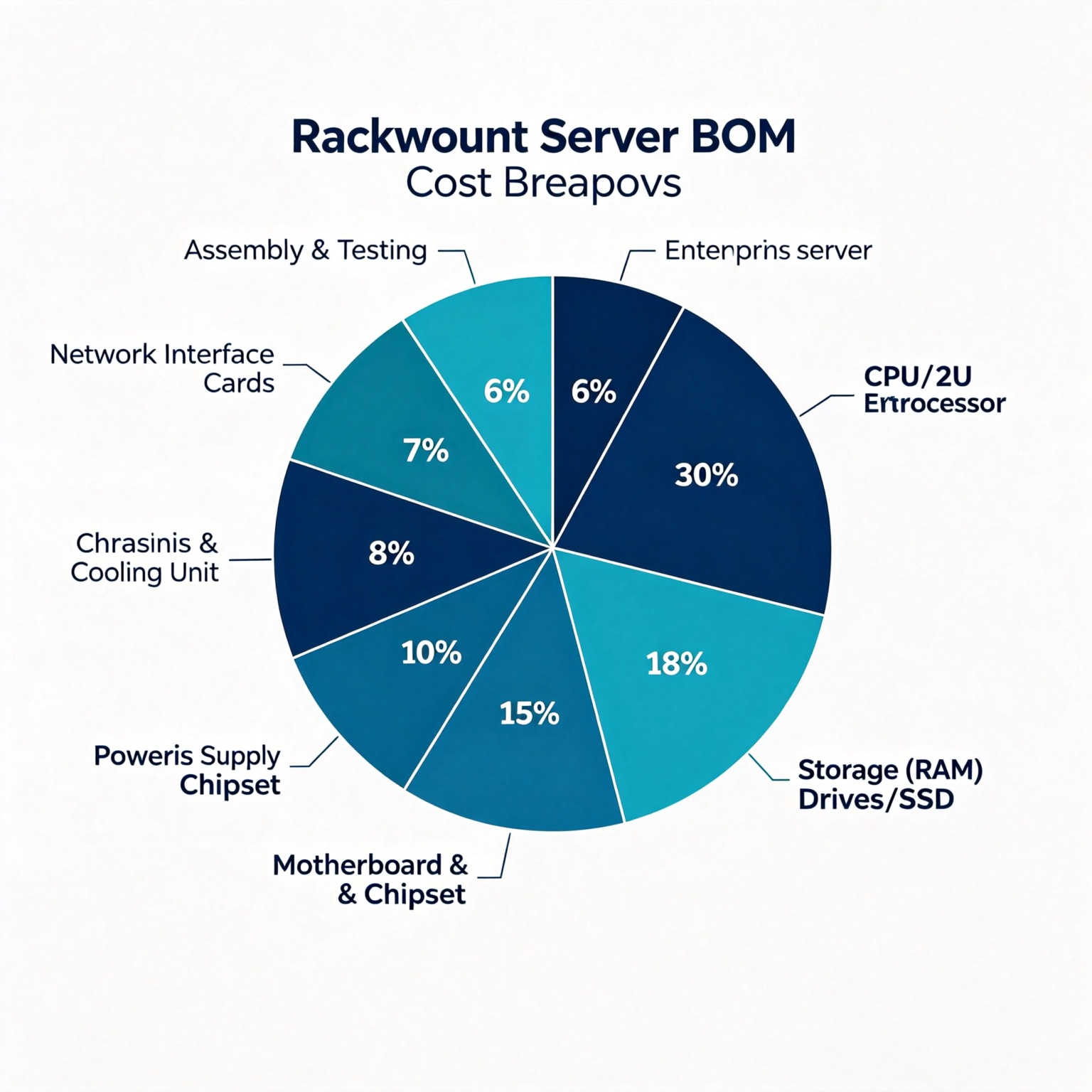
- CPU/Processor (30%): Intel Xeon or AMD EPYC. The single largest cost component. Prices vary dramatically by SKU — from $200 entry Xeon to $10,000+ top Platinum/EPYC models.
- Memory / RAM (18%): DDR4/DDR5 RDIMM/LRDIMM. Enterprise-grade ECC memory. Pricing scales with capacity and speed grade.
- Storage Drives (15%): SSDs (SATA/NVMe) and HDDs (SAS/SATA). Enterprise drives command significant premium over consumer grade.
- Motherboard & Chipset (10%): Server-grade motherboard with BMC (Baseboard Management Controller), multiple PCIe lanes, redundant BIOS.
- Chassis & Cooling (8%): Sheet metal chassis, drive cages, hot-swap backplanes, fan assemblies. Higher for specialized designs.
- Power Supply Unit (7%): Redundant, high-efficiency (80 Plus Platinum/Titanium). Server PSUs are a critical reliability component.
- Network Interface Cards (6%): 1GbE, 10GbE, 25/100GbE options. Built-in or add-on cards.
- Assembly, Testing & Overhead (6%): SMT, assembly, quality control, burn-in testing, packaging, factory margin.
5.3 MOQ Realities for Server Sourcing
- Ready-to-Ship (RTS) / Distribution: MOQ = 1 unit. Branded servers through distributor channels. Standard configurations only. Highest per-unit cost.
- Configure-to-Order (CTO): MOQ = 10–50 units. Choose CPU, memory, storage, and RAID config from a standard chassis platform. Logo printing possible.
- Semi-Custom (ODM platform, modified): MOQ = 50–200 units. Modify existing ODM reference design: custom BIOS, port layout, branding, packaging.
- Full Custom Design (ODM): MOQ = 500–5,000+ units per year. Custom chassis, motherboard, thermal design. NRE fees apply ($50k–$500k+).
Important Note on Component Pricing Volatility: Server component prices (especially CPUs, memory, and SSDs) fluctuate significantly based on market supply/demand cycles. Quotes are typically valid for 7–14 days only. Lock in pricing with a purchase order when you’re ready to buy — don’t rely on quotes from months prior.
6. Compliance & Certification Requirements
Server equipment is subject to strict regulatory requirements in every major market. Unlike consumer electronics, servers are classified as commercial/industrial equipment with different standards (e.g., FCC Class A vs. Class B). Non-compliance results in customs seizure, fines, and liability for data center operators.
6.1 HS Code Classification
Correct HS classification determines duty rates and import requirements. Standard codes for server and data center equipment:
| Product | HS Code (6-digit) | Notes |
|---|---|---|
| Server units (rackmount/tower) | 8471.41 / 8471.49 | Digital processing units comprising CPU and memory. Most common code for complete servers. |
| Server (processing unit only) | 8471.50 | Automatic data processing machines, other |
| Storage systems / disk arrays | 8471.70 | Storage units. Some jurisdictions classify under 8471.41 |
| Server racks / network cabinets | 8471.80 or 9403.20 | 8471.80 = IT equipment enclosures (lower duty); 9403.20 = furniture classification. Must prove IT function for 8471.80. |
| Server parts (motherboards, PSUs) | 8473.30 | Parts and accessories of machines of heading 8471 |
| Network switches / routers | 8517.62 | Telecommunications apparatus — different regulatory regime |
| UPS / power supplies | 8504.40 | Static converters / uninterruptible power supplies |
Critical Note on AI/GPU Servers: High-end AI servers with advanced GPUs (Nvidia A100, H100, H200, AMD MI300 class) may be subject to export control restrictions from both China (dual-use technology regulations) and the US (EAR rules affecting China-origin products with US components). Verify export license requirements with your supplier and customs broker before ordering. This is the #1 cause of shipment seizures and project delays for AI infrastructure imports.
6.2 European Union (EU/EEA) Requirements
| Certification | Details for Server Equipment |
|---|---|
| CE Marking | Mandatory. Covers LVD (Low Voltage Directive 2014/35/EU, EN 60950-1 / EN 62368-1) and EMC (Electromagnetic Compatibility 2014/30/EU, EN 55032 emission / EN 55035 immunity). Servers are Class A (commercial/industrial) equipment — different limits than Class B consumer products. |
| RED (Radio Equipment Directive) | Mandatory if server includes Wi-Fi, Bluetooth, cellular, or any radio transmitter (e.g., BMC remote management with wireless). 2014/53/EU. |
| RoHS 2 | Restriction of Hazardous Substances (2011/65/EU). Non-compliance fines up to €50,000 per violation in some EU member states. |
| WEEE | Waste Electrical and Electronic Equipment. Producer responsibility — must register and fund recycling. Servers fall under Category 3 (IT and telecommunications equipment). |
| REACH / SCIP | SVHC declaration required. SCIP database notification for articles containing substances of very high concern. |
| ErP / Ecodesign | Energy-related Products Directive. Servers and data center equipment have specific efficiency requirements under EU Ecodesign regulations. |
| EU Battery Regulation | Applies to RAID controller batteries, UPS batteries, and backup power modules. Battery passport and carbon footprint requirements phasing in 2026–2028. |
6.3 United States Requirements
| Certification | Details for Server Equipment |
|---|---|
| FCC (Class A) | Mandatory for all electronic equipment. Servers are Class A digital devices (commercial/industrial environment) per FCC Part 15. Supplier’s Declaration of Conformity (SDoC) pathway acceptable for unintentional radiators. Verify FCC ID for any radio components. |
| UL / ETL / NRTL Listing | Not federally mandatory but required by OSHA at state/local level and by virtually all data center operators and enterprise buyers. UL 60950-1 / UL 62368-1 standard. NRTL (Nationally Recognized Testing Laboratory) listing is expected for commercial IT equipment. |
| ENERGY STAR for Servers | Voluntary but commonly required for government procurement and enterprise RFPs. Version 3.0 specification covers rack, pedestal, and blade servers. PSU power factor and idle power requirements. |
| Section 301 Tariffs | Additional tariffs apply to many China-origin electronics under US-China trade measures. Verify current HTSUS codes and exclusion status. Some server equipment may be excluded or subject to different rates. |
| California Prop 65 | Warning label requirement if product contains listed chemicals above threshold levels. |
6.4 Other Major Markets
- India: BIS (Bureau of Indian Standards) certification compulsory for servers under IT hardware category. DGFT Import Authorization may be required. WPC Equipment Type Approval for wireless components. IGST applies at import.
- UK: UKCA marking (post-Brexit CE replacement). CE marking still accepted during transition periods — verify current deadline.
- Australia / New Zealand: RCM (Regulatory Compliance Mark) for EMC and electrical safety.
- Japan: PSE Mark (electrical safety, DENAN Law) + TELEC / Giteki for radio equipment. VCCI for EMC (voluntary but widely expected).
- Latin America: NOM (Mexico), ANATEL (Brazil — especially important for telecom/networking equipment).
- Middle East / GCC: SASO (Saudi Arabia), GSO (Gulf Standardization Organization), CB scheme widely accepted.
6.5 Data Center-Specific Standards
Beyond regulatory certifications, enterprise and data center buyers often require additional standards:
- 80 Plus: Power supply efficiency certification (Bronze, Silver, Gold, Platinum, Titanium). Data centers typically require Platinum or Titanium grade.
- OCP (Open Compute Project): Open hardware design standard used by hyperscalers. Relevant if sourcing white-box servers for OCP deployments.
- NEBS (Network Equipment-Building System): Telco-grade standard required by telecom operators (GR-63, GR-1089).
- TAA / BAA Compliance: Trade Agreements Act / Buy American Act — required for US federal government procurement. Affects country-of-origin rules.
- ISO 9001 / ISO 14001: Factory quality and environmental management certifications.
7. Logistics, Shipping & Incoterms
Servers and data center equipment have unique logistics challenges: heavy weight, high value, fragile components, lithium batteries (in RAID controllers and UPS), and often project-level deployment timelines.
7.1 Weight & Dimensional Considerations
- Single 1U/2U server: 15–30 kg (33–66 lbs) per unit, depending on configuration and drive count
- 4U storage server: 30–60 kg (66–132 lbs) with drives installed
- Empty 42U rack: 80–150 kg (176–330 lbs)
- Fully populated 42U rack: 500–1,500+ kg (1,100–3,300+ lbs) — requires specialized handling and loading equipment
- AI/GPU server (8× GPU): 50–80 kg per unit, with 3–5 kW power draw
7.2 Common Incoterms for Server Equipment
| Incoterm | Seller Responsibility | Buyer Responsibility | Common Use |
|---|---|---|---|
| EXW | Make goods available at factory gate | All transport, export clearance, duties, delivery | Rare for servers |
| FOB | Deliver to port vessel, export clearance | Ocean freight, insurance, import, delivery | Most common for container loads |
| CIF | FOB + freight + insurance to destination port | Import clearance, duties, inland delivery | Common for LCL shipments |
| DAP | Deliver to buyer’s location (no duties paid) | Import clearance, duties, taxes | Project cargo / rack deliveries |
| DDP | Deliver duty-paid to buyer’s door | Receive goods only | Small orders, turnkey projects |
7.3 Shipping Modes & Transit Times
| Shipping Mode | Transit Time | Cost per kg | Best For |
|---|---|---|---|
| Express Courier | 3–7 days door-to-door | $6 – $15 | Samples, spare parts, single-unit orders under 70kg |
| Air Freight | 7–14 days | $3.50 – $8 | Urgent deployments, high-value GPU servers, 100–1000kg |
| Sea Freight (FCL) | 25–40 days | $0.50 – $2 | Full container orders, rack + equipment shipments, cost optimization |
| Sea Freight (LCL) | 30–50 days | $1 – $3.50 | Partial container loads (1–10 CBM) |
| Project Cargo / Breakbulk | 30–60 days | Custom quote | Full data center deployments, pre-racked servers, oversized equipment |
7.4 Special Logistics Considerations
Lithium Battery Shipping
- Servers with RAID controller batteries, BBU (Battery Backup Unit), or CMOS batteries contain lithium cells
- Must comply with UN38.3 test standard and IATA / IMDG dangerous goods regulations
- PI967 Section II standard provision for equipment with installed batteries
- UPS units with large batteries have separate, stricter classification
- Always request MSDS / SDS and battery UN38.3 test reports from supplier
Shock, Vibration & ESD Protection
- Server hard drives and SSDs are sensitive to shock during shipping
- Quality packaging should include: anti-static bags, foam cushioning, corner protectors, shock indicator labels
- For full rack shipments: custom crating, shockwatch indicators, tilt indicators
- Consider removing and separately packaging hard drives for high-vibration transport routes
Insurance
- Servers are high-value cargo — always insure for 110% of CIF value
- Standard cargo insurance may not cover data center equipment adequately — verify policy terms
- Consider all-risk cargo insurance with specific electronics / IT equipment coverage
7.5 Required Shipping Documents
- Commercial Invoice (with HS codes, unit values, country of origin, Incoterms, serial numbers for high-value equipment)
- Detailed Packing List (per carton: model, serial numbers, weight, dimensions)
- Bill of Lading (sea) or Air Waybill (air)
- Certificate of Origin (Form A / preferential tariff treatment where applicable)
- MSDS / SDS for lithium batteries
- Certification copies (CE, FCC, UL, RoHS, ENERGY STAR as applicable)
- Insurance Certificate
- Export license / dual-use declaration (for AI/GPU servers where required)
8. Payment Terms & Financial Risk Management
8.1 Common Payment Methods for Server Procurement
| Method | How It Works | Buyer Risk | Typical Usage |
|---|---|---|---|
| T/T (Telegraphic Transfer) | Bank wire transfer. Standard: 30% deposit on order, 70% balance before shipment. | Medium (deposit at risk) | Most common for established supplier relationships |
| L/C (Letter of Credit) | Bank guarantee of payment upon presentation of compliant shipping documents. UCP 600. | Low | First-time orders, high-value orders ($100k+), AI/GPU servers |
| D/P (Documents against Payment) | Shipping documents released by bank only after buyer pays. | Medium-Low | Mid-sized orders with semi-established suppliers |
| Alibaba Trade Assurance | Escrow service. Payment released after goods received and inspected. | Low | Alibaba platform orders, first-time small orders |
| O/A (Open Account) | Payment Net 30 / Net 60 / Net 90 days after delivery. | Very Low | Only with long-term trusted suppliers / major brands |
| Credit Card / PayPal | Fast but high fees (3–5%). Chargeback protection. | Lowest | Samples only, orders under $5,000 |
8.2 Standard Payment Structure
Server industry standard for OEM/ODM orders:
- 30% Deposit — Paid upon PO confirmation. Supplier purchases components (CPU, memory, drives) and begins production.
- 70% Balance — Paid before shipment, after pre-shipment inspection and receipt of B/L copy.
For high-value AI/GPU server orders (>$250,000), consider negotiating a 20/60/20 structure with 20% held until after delivery and acceptance testing. Most Tier-1 ODMs will resist this, but mid-tier suppliers may be flexible.
8.3 NRE & Tooling Costs
For custom ODM designs, expect additional upfront costs:
- NRE (Non-Recurring Engineering): $50,000 – $500,000+ depending on design complexity. Covers PCB design, firmware, thermal engineering, compliance testing, and certification.
- Tooling / Mold Cost: $10,000 – $100,000 for custom chassis, sheet metal tooling, plastic injection molds.
- Certification Testing: $15,000 – $50,000 for CE/FCC/UL testing of new models.
- These costs are typically amortized over the production volume. Some ODMs waive NRE if you commit to a minimum annual volume.
8.4 Payment Security Best Practices
- Always pay to official company bank accounts — never personal accounts
- Verify bank account name matches business license exactly
- Be extremely wary of “our bank account has changed” emails — always verify by phone with a known contact
- For AI/GPU server orders, use L/C to ensure export license and compliance documentation are in order before payment
- Consider trade credit insurance for ongoing procurement programs above $500k/year
- Component price volatility is high — include price validity period (7–14 days) in all quotes and POs
9. Quality Control & Factory Audit Framework
Server quality is mission-critical. A single server failure in a data center can cause significant downtime and financial loss. Quality control for servers is more rigorous than for consumer electronics and must include extended burn-in testing.
9.1 Five-Stage Quality Control Process
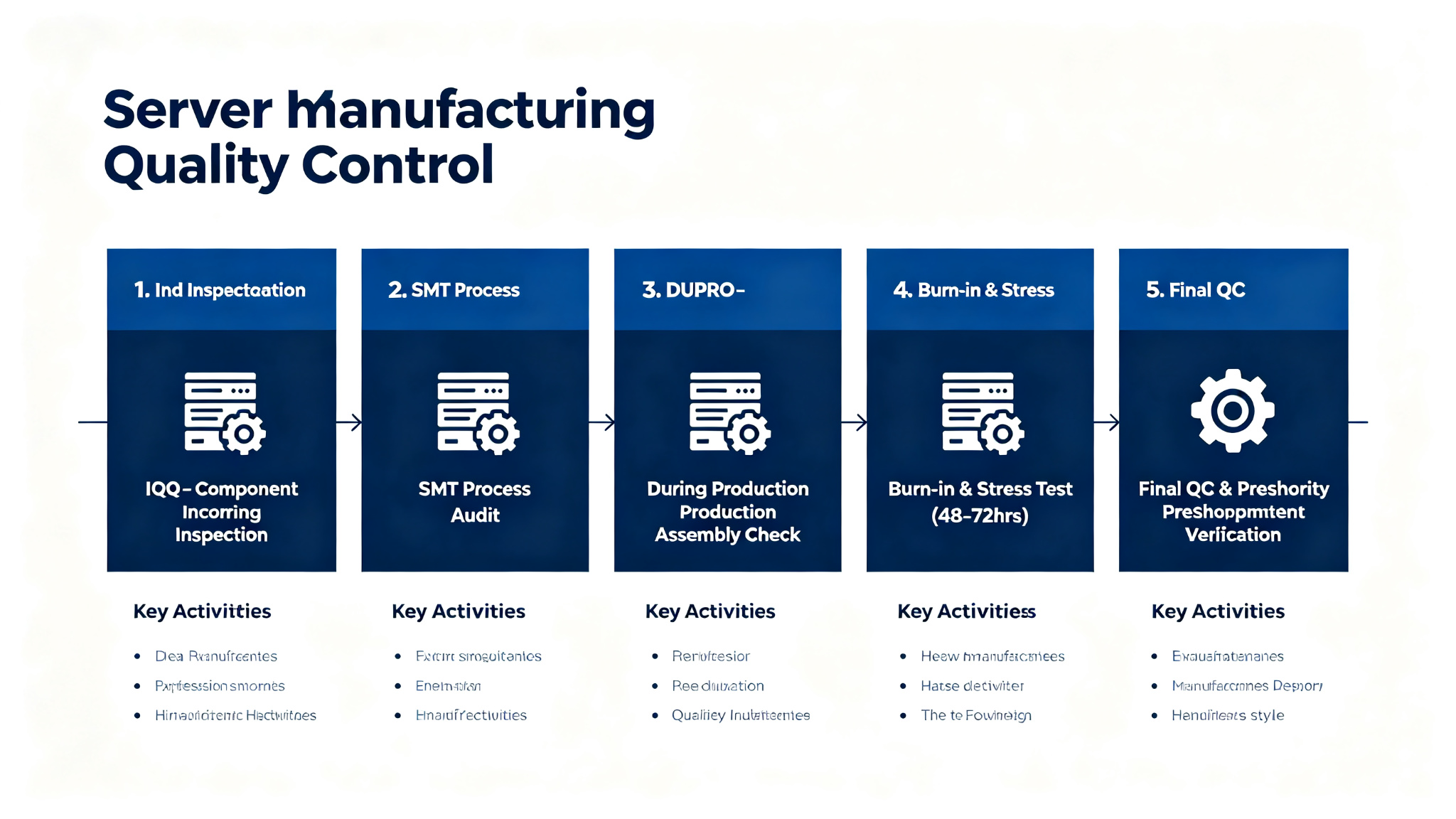
Stage 1: IQC — Incoming Quality Control
Timing: Before production starts, upon component receipt
Key checks:
- CPU, memory, storage components match specification — verify part numbers and authenticity
- Motherboard and BMC chipset are correct revision
- Power supplies have valid 80 Plus certification and safety marks
- Hard drives / SSDs are enterprise grade, not consumer grade (verify model numbers)
- Component traceability documentation (batch/lot numbers)
- Counterfeit component screening — especially for memory modules and CPUs
Stage 2: SMT Process Audit
Timing: During motherboard / PCB assembly
Key checks:
- SMT (Surface Mount Technology) line quality and process control
- Solder paste inspection (SPI) results
- Automated Optical Inspection (AOI) pass rates
- X-ray inspection for BGA components (CPU socket, chipset)
- IPC-A-610 standard compliance
Stage 3: DUPRO — During Production Inspection
Timing: When 20–40% of units are assembled
Key checks:
- Assembly workmanship: cable routing, screw torque, heat sink mounting
- First Article Inspection (FAI) against golden sample
- Defect rate tracking (target: <1.5% for server assembly)
- BIOS / BMC firmware version and configuration
- Production on schedule per agreed timeline
- Component substitutions — verify no unauthorized swaps
Stage 4: Burn-in & Stress Testing
Timing: After assembly, before final QC — 48 to 72 hours minimum
This is the most critical stage for server quality.
- CPU stress test: Prime95, Linpack, or equivalent — full load for extended period
- Memory test: Memtest86+ / OEM diagnostic — full pass on all DIMMs
- Storage test: Full read/write cycles on all drives, SMART health check
- Thermal test: Verify CPU/GPU temperatures within spec under full load
- Power supply test: Redundant PSU failover testing
- Network test: All NIC ports functional, throughput verification
- Cycle test: Multiple power on/off cycles to test boot reliability
- Any unit that fails during burn-in must be repaired and go through a full new burn-in cycle — no exceptions
Stage 5: Final QC & Pre-Shipment Verification
Timing: After burn-in and packaging, before container loading
Key checks:
- AQL Level II sampling (standard for enterprise electronics)
- Final functional test: boot test, all ports, BMC/IPMI access, RAID configuration
- Cosmetic inspection: chassis condition, scratches, panel alignment
- Firmware / BIOS configuration matches customer specification
- Packaging quality: anti-static bags, foam cushioning, shock indicators
- Accessories complete: power cords, rack rails, driver media, documentation
- Serial numbers recorded and matched to packing list
- Shipping marks, labels, and barcodes correct
- Container loading supervision recommended for FCL shipments
9.2 Third-Party Inspection Companies
Use independent third-party inspection agencies for objective quality verification:
- SGS — Largest globally, comprehensive IT/electronics inspection capability, ~$300–500/man-day
- Bureau Veritas (BV) — Major global player, strong in industrial electronics
- TÜV Rheinland / TÜV SÜD — German firms, strong certification + inspection, high standards
- Intertek — UK-based, broad electronics expertise
- HQTS — Mid-tier, good value for standard inspections
Cost reference: Standard PSI = 1 man-day ($250–500). Full factory audit = 1–2 man-days. Burn-in witnessing = 2–3 man-days. This is the single best investment to reduce server sourcing risk — one DOA server can cost more in downtime and replacement than the entire inspection fee.
9.3 Factory Audit Checklist for Server Manufacturers
Legal & Business Verification
- Valid business license with matching registered name and address
- Registered capital (expect RMB 10M+ for serious server manufacturers)
- Import/export license
- ISO 9001 quality management certification
- ISO 14001 environmental certification
- OHSAS 18001 / ISO 45001 occupational health
Production Capability
- SMT lines — how many, what generation, automated?
- Assembly line capacity (servers per month, per shift)
- Burn-in room capacity — how many units can run simultaneously?
- Number of employees, engineering team size
- Current order backlog — can they actually meet your delivery date?
- Test equipment: oscilloscopes, thermal chambers, network analyzers
Quality System Specific to Servers
- Standard burn-in duration (must be ≥48 hours — reject any factory with <24 hours)
- Defect tracking and corrective action system (CAPA)
- Component traceability system — can they trace a failed component back to batch?
- IPC-A-610 training for assembly workers
- ESD (Electrostatic Discharge) control program — essential for electronics
- Calibration records for all test equipment
Supply Chain & Component Sourcing
- CPU supplier — are they Intel/AMD authorized distributors? (Counterfeit CPUs are a real risk)
- Memory and storage suppliers — enterprise grade vs. consumer grade
- Component counterfeit prevention measures
- Battery supplier has UN38.3 and IEC 62133 certifications
- Alternative sources for critical components (supply chain resilience)
10. Common Pitfalls & Risk Management
10.1 Top 10 Risks for Server Importers
| # | Risk | Mitigation Strategy |
|---|---|---|
| 1 | Counterfeit / Re-marked Components | Specify exact part numbers in PO; IQC component verification; use authorized distributors; reject suspiciously low quotes; third-party lab testing for high-value components. |
| 2 | Consumer-Grade Parts in Enterprise Servers | Specify enterprise-grade components (Xeon, ECC RAM, SAS/SATA enterprise HDD/SSD, server-grade PSUs); verify model numbers against manufacturer datasheets; DUPRO inspection. |
| 3 | Insufficient Burn-in Testing | Contractually require minimum 48-hour (preferably 72-hour) burn-in with stress testing; witness burn-in via third party or factory visit; DOA rate tracking on receipt. |
| 4 | Export Control Violations (AI/GPU) | Verify EAR / dual-use classification before ordering; confirm supplier has export license; use L/C with export document requirements; consult trade compliance lawyer for high-end AI hardware. |
| 5 | Invalid / Fake Certifications | Verify CE certificates via NANDO database; verify FCC IDs in FCC OET; request full test reports (not just certificate images); confirm model numbers match exactly — not just “similar” models. |
| 6 | Shipping Damage to Drives | Require anti-static packaging, foam cushioning, shock indicator labels; consider removing drives and shipping separately for high-vibration routes; insure cargo properly; inspect immediately on receipt. |
| 7 | Component Price Volatility | Short price validity (7–14 days); lock pricing with PO deposit; build price fluctuation clause into contracts; monitor DRAM/NAND spot prices for large orders. |
| 8 | Firmware / BIOS Issues | Specify exact firmware version in PO; test sample units thoroughly for BMC/IPMI functionality, security features, boot stability; require firmware update support commitment. |
| 9 | Warranty & RMA Problems | Define warranty terms clearly (3 years parts/labor standard for enterprise); negotiate spare parts buffer (2–5% of order value); clarify cross-shipping policy and who pays return freight. |
| 10 | Trading Company Posing as Factory | Verify factory address via video tour and third-party audit; check business license scope of business; ask specific technical questions about SMT lines and burn-in capacity; trading companies cannot answer these in detail. |
10.2 Red Flags in Server Suppliers
- Prices 30%+ below market average — they are likely using consumer-grade or counterfeit components
- Refusal to provide burn-in test reports or discuss burn-in procedures
- Cannot provide exact component part numbers and datasheets
- Certificates show different model numbers than the product you’re ordering
- Company registered less than 2 years ago with no server-specific track record
- Unwilling to accept third-party inspection
- Push for 100% upfront payment or personal bank accounts
- Vague answers about SMT lines, burn-in capacity, or engineering team size
10.3 Warranty Strategy for Server Importers
Server warranty is fundamentally different from consumer PC warranty. Plan your warranty strategy before sourcing:
- Factory warranty: Typically 1–3 years from factory. Requires return to China for repair — slow and expensive.
- Self-warranty / local repair: Maintain spare parts inventory (motherboards, PSUs, fans, drives) and perform local repairs. Most cost-effective for volume deployments.
- Third-party maintenance: Contract with local IT service companies for on-site support. Common for enterprise resellers.
- Spare parts buffer: Negotiate 2–5% spare parts included with each order (or at cost). Standard practice in the server industry.
- Advanced replacement: For premium positioning, ship replacement unit before receiving failed unit back. Requires spare inventory.
11. Step-by-Step Procurement Action Plan
This 12-step roadmap guides you from initial requirements definition to final deployment and warranty setup. Server procurement requires more technical due diligence than consumer electronics — allocate sufficient time for technical evaluation and compliance verification.
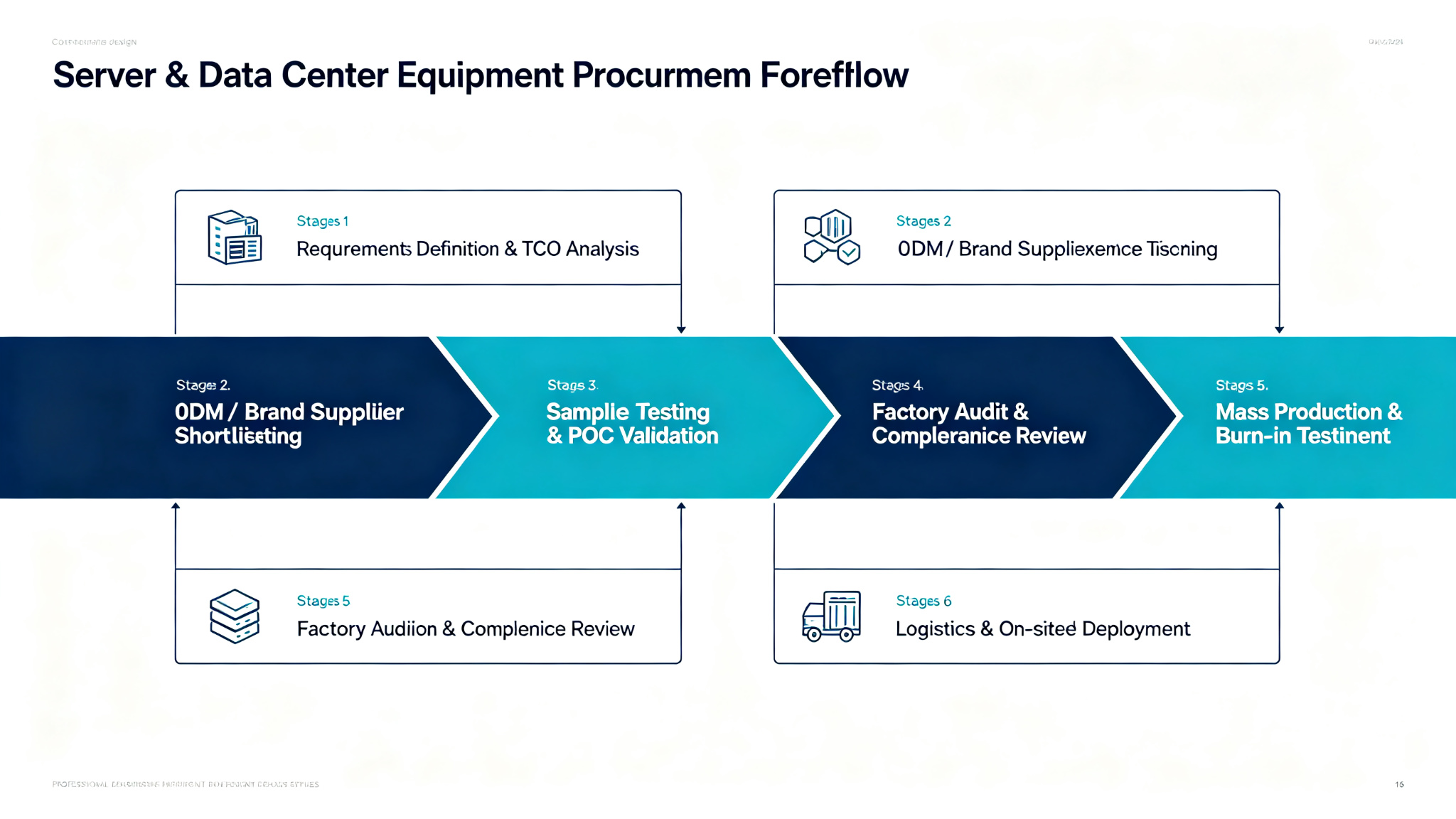
Phase 1: Requirements & TCO Analysis (Weeks 1–3)
Step 1: Define Technical Specifications & TCO
- Document exact server specifications: form factor (1U/2U/4U), CPU model and count, memory capacity and type (ECC RDIMM required), storage (HDD/SSD count and interface), NIC ports (1GbE/10GbE/25GbE), PSU redundancy, RAID controller
- Define target workload: general compute, storage, virtualization, AI/GPU, edge computing
- Calculate Total Cost of Ownership (TCO): hardware + shipping + duties + warranty/spares + power consumption over 3–5 years
- Determine target market certifications required (CE, FCC, UL, ENERGY STAR, etc.)
- Set budget range and order quantity
- Create a detailed technical specification document to send to all suppliers
Step 2: Supplier Market Research & Longlisting
- Search Alibaba.com, Made-in-China.com, Global Sources using exact specs
- Identify potential suppliers across categories: Tier-1 ODMs (if volume qualifies), domestic brands (Inspur, Lenovo, H3C), mid-tier white-box ODMs (Shenzhen/Suzhou)
- Check supplier transaction history, certifications, and factory age on platforms
- Identify 8–12 potential suppliers for initial outreach
- Verify which suppliers already hold certifications for your target market
Phase 2: Supplier Evaluation (Weeks 4–8)
Step 3: Send RFQ & Technical Questionnaire
- Send detailed spec sheet + technical questionnaire to all longlisted suppliers
- Request: FOB unit price, MOQ, lead time, payment terms, sample cost and lead time
- Ask technical questions: burn-in duration, BMC firmware type, component sourcing, MTBF data, warranty terms
- Request: factory audit reports, certification copies (with model numbers), existing client references
- Request component BOM with exact part numbers for CPU, memory, drives, PSU
- Set response deadline (5–7 business days)
Step 4: Evaluate Quotes & Shortlist 3–5 Suppliers
- Compare total landed cost, not just unit price (include shipping, duties, warranty cost)
- Eliminate suspiciously low quotes — they usually cut corners on components or testing
- Assess technical depth of responses — quality suppliers give detailed technical answers
- Verify certifications match your target market and exact model
- Select 3–5 suppliers for sample / evaluation unit ordering
Step 5: Order & Test Evaluation Units
- Order 1–2 evaluation units from each shortlisted supplier (expect to pay sample fee + shipping)
- Conduct thorough technical testing: performance benchmarks, thermal testing under full load, 24–48 hour burn-in, BMC/IPMI functionality, power consumption measurement
- Verify component part numbers against specification — open the chassis and check
- Test firmware update process, BIOS configuration options, remote management features
- Document all findings photographically and with test logs
- Select 1–2 finalists based on quality, performance, price, and communication
Step 6: Factory Audit & Compliance Verification
- For orders > $30,000, hire third-party inspector for on-site factory audit
- Verify production capacity, SMT lines, burn-in room, quality systems, ESD control
- Review component sourcing and counterfeit prevention measures
- Verify certification test reports — check model numbers match exactly
- For AI/GPU servers: verify export licensing capability and compliance procedures
- Address any major non-conformities before placing order
Phase 3: Order Execution (Weeks 9–16)
Step 7: Negotiate & Sign Purchase Agreement
- Negotiate final pricing, MOQ, lead time, payment terms, warranty, and spare parts
- Sign formal purchase agreement / proforma invoice with all terms documented
- Include: detailed BOM with part numbers, burn-in requirements (48–72 hours minimum), quality standards (AQL levels), delivery date, defect rate acceptance criteria, penalty for delay, IP terms, warranty and RMA process
- Attach golden sample specification as contract appendix
- Include component price validity clause and price adjustment mechanism for major component price swings
- Arrange deposit payment (typically 30% T/T)
Step 8: Production Monitoring & DUPRO
- Request weekly production updates with photos
- Schedule DUPRO inspection at 30–40% production completion
- Verify component brands and part numbers match agreed BOM
- Check assembly quality and workmanship
- Address any quality issues immediately — corrections are cheaper during production
- Track production timeline against agreed delivery date
Step 9: Burn-in Witnessing & Pre-Shipment Inspection
- Optionally arrange third-party witnessing of burn-in testing (recommended for first order)
- Schedule PSI when 100% of units are tested, packaged, and ready to ship
- Use AQL Level II sampling: 2.5% major defects, 4.0% minor
- Functional testing on sampled units: boot test, all ports, BMC access, RAID config, PSU redundancy
- Verify packaging quality, shock indicators, anti-static protection
- Verify serial numbers recorded correctly
- Fail inspection if major defects exceed AQL — require rework and re-inspection at supplier cost
- Only pay 70% balance after PSI passes and you receive copy of shipping documents
Phase 4: Delivery & Post-Sales (Weeks 16–20+)
Step 10: Shipping & Customs Clearance
- Confirm booking with freight forwarder experienced in IT / data center equipment
- Verify all shipping documents: commercial invoice with HS codes, packing list with serial numbers, B/L, certificates, MSDS for batteries
- For AI/GPU servers: verify export license documentation is complete and correct
- Provide documents to customs broker for pre-clearance
- Arrange cargo insurance (all-risk, 110% of CIF value)
- Track shipment and coordinate destination delivery / white-glove handling if needed
Step 11: Receiving Inspection & Deployment Testing
- Inspect all cartons for shipping damage immediately upon receipt — note damage on delivery receipt before signing
- Photograph any damaged packaging before opening
- Test 10–15% of units: power-on test, boot into BIOS, check hardware configuration matches spec, run quick diagnostic
- Verify all accessories, rack rails, and documentation are included
- Record serial numbers for asset management
- File any freight damage claims within carrier’s time window
- Track DOA (Dead on Arrival) rate — should be <1% from a quality supplier
Step 12: Establish Warranty & Spare Parts System
- Set up RMA (Return Merchandise Authorization) process with supplier
- Establish local spare parts inventory based on agreed buffer (2–5% of order)
- Track field failure rates over first 90 days and 12 months
- Provide quality feedback to supplier for continuous improvement
- Build relationship for future orders and volume discounts
- Maintain at least 2 qualified suppliers to mitigate single-source risk
- Plan end-of-life / last-time-buy strategy for server models (typical 3–5 year product lifecycle)
12. Conclusion & Strategic Recommendations
12.1 Summary of Key Success Factors
- Choose the right sourcing model. White-box ODM direct saves 20–35% but requires technical capability and volume. Branded servers cost more but include global warranty and support. Match the model to your business capability and customer type.
- Component verification is critical. The #1 quality risk in China server sourcing is component substitution — consumer-grade drives, non-ECC memory, re-marked CPUs. Specify exact part numbers and verify during DUPRO.
- Burn-in testing is non-negotiable. Require minimum 48-hour (preferably 72-hour) burn-in with full stress testing. This catches 80% of infant mortality failures before shipment.
- Export compliance for AI servers. GPU-accelerated servers may be subject to dual-use export controls from both China and the US. Verify compliance before ordering — seized shipments are not recoverable.
- Plan for warranty locally. Factory warranty from China is slow and expensive to exercise. Build a spare parts strategy and local repair capability — it’s standard practice in the server industry.
12.2 Recommended Sourcing Strategy by Importer Type
Small Importer / Reseller (10–100 units/year)
- Start with branded distribution (Lenovo, Inspur international channels) — lower risk, established warranty
- Or source mid-tier white-box from Shenzhen verified factories with Alibaba Trade Assurance
- Use third-party PSI on every order
- Focus on a specific niche (storage servers, edge servers, etc.) to build volume with one supplier
Medium Importer / ISP / Hosting (100–1,000 units/year)
- Engage directly with mid-tier ODMs in Shenzhen/Suzhou for semi-custom white-box servers
- Negotiate 30/70 payment terms, 3-year warranty, 3% spare parts buffer
- Conduct annual factory audits and DUPRO on every batch
- Dual-source from two factories to mitigate supply risk
- Consider own-brand private labeling once volume is stable
Large Enterprise / Data Center Operator (1,000+ units/year)
- Engage Tier-1 ODMs (Foxconn, Quanta, Wistron, Wiwynn) for custom ODM/JDM programs
- Negotiate NRE amortization, volume pricing tiers, and O/A payment terms
- Establish on-site QC team or dedicated third-party inspection at factory
- Consider OCP (Open Compute Project) standard designs for cost optimization
- Evaluate China+1 diversification (Vietnam, Mexico) for tariff and geopolitical risk mitigation
12.3 Future Trends to Monitor
- AI Server Boom: Demand for GPU-accelerated servers is growing rapidly. Supply constraints on high-end GPUs (Nvidia H100/H200) affect lead times and pricing. Export controls add complexity.
- ARM Architecture Growth: Huawei Kunpeng, Ampere, and AWS Graviton are driving ARM server adoption. Chinese domestic ARM server ecosystem is developing rapidly but still dependent on TSMC for advanced manufacturing.
- Energy Efficiency Regulations: EU Ecodesign and ENERGY STAR v3.0 are tightening server power efficiency requirements. Select suppliers with strong thermal engineering capability.
- Supply Chain Diversification: Many hyperscalers and brands are diversifying production to Southeast Asia (Vietnam, Thailand, Malaysia) and Mexico. China remains the dominant base but secondary locations are growing.
- Liquid Cooling: High-density AI servers are driving adoption of liquid cooling solutions. If sourcing >10kW per rack equipment, verify liquid cooling capability of suppliers.
Appendix A: Quick Reference Checklist
Before Ordering
- Detailed technical specification sheet finalized (CPU PNs, memory type, storage specs)
- Target market certifications identified (CE/FCC/UL/ENERGY STAR/etc.)
- HS codes verified with local customs broker
- Export control classification verified (for AI/GPU servers)
- 8–12 suppliers identified and RFQ sent with technical questionnaire
- Evaluation units ordered and thoroughly tested (performance, thermal, burn-in)
- Component part numbers verified against spec (open chassis check)
- Factory audit conducted (for orders > $30k)
- Certificates verified in official databases (NANDO, FCC OET, etc.)
- Purchase agreement signed with detailed BOM, burn-in requirements, warranty terms
During Production
- 30% deposit paid to verified company bank account
- Weekly production updates requested
- DUPRO inspection scheduled at 30–50% completion
- Component brands and PNs verified against agreed BOM
- Burn-in testing duration confirmed (minimum 48 hours)
- Production timeline tracking against delivery date
Before Shipment
- Pre-shipment inspection (PSI) booked with third party
- AQL Level II inspection passed (2.5% major, 4.0% minor)
- Functional testing verified on sample units (boot, ports, BMC, RAID, PSU)
- Packaging quality verified (anti-static, foam, shock indicators)
- Serial numbers recorded and matched to packing list
- All shipping documents reviewed for accuracy
- Export license verified (for AI/GPU servers)
- 70% balance paid only after PSI pass + document review
- Cargo insurance arranged (all-risk, 110% CIF)
After Delivery
- Cartons inspected for shipping damage on receipt (before signing)
- 10–15% of units power-on tested and config verified
- Accessories, rack rails, documentation verified complete
- DOA rate tracked (target: <1%)
- Freight damage claims filed within carrier window (if applicable)
- RMA process established with supplier
- Spare parts inventory set up (2–5% of order quantity)
- Field failure rate tracking over 90 days and 12 months
- Supplier performance review documented
Disclaimer: This report is for informational purposes only and does not constitute legal, customs, tax, or trade compliance advice. Server and data center equipment import regulations, especially for AI/GPU hardware, are complex and change frequently. Always consult licensed customs brokers, trade compliance specialists, and legal advisors for your specific market and product configuration. Pricing and MOQ data are approximate benchmarks as of 2025–2026 and may vary based on configuration, order volume, component market conditions, and supplier negotiation. Component prices (CPU, memory, storage) are highly volatile — always confirm current pricing before placing orders.
“Need help sourcing from China? Email us at harry@plumwheat.com”