
Buying several styles of leisure chairs from China does not always mean placing the entire order with one factory. A supplier may be able to offer every model on a buyer’s list, but that does not necessarily mean it has the strongest price, product quality or packing solution for every chair.
In a 2015 project for a European buyer, we sourced 980 leisure chairs for one 40HQ container. The order covered 13 model codes and 20 model-and-colour combinations. We compared quotations from six factories, reviewed samples and finally divided the order between two suppliers.
One supplier produced the one-piece moulded chairs, including PW885, PW884 and PW855. A second supplier produced the other chair models. All finished goods were delivered to our Ningbo warehouse, where we coordinated inspection and loaded them together into one container.
This case shows how model-by-model supplier selection, sample approval, packing design and shipment consolidation can be combined in one purchasing project.
Project at a Glance
| Item | Confirmed project information |
|---|---|
| Project year | 2015 |
| Buyer | Anonymised European buyer |
| Product | Multiple leisure chair styles |
| Factories compared before ordering | 6 |
| Suppliers finally selected | 2 |
| Model codes | 13 |
| Model-and-colour combinations | 20 |
| Total quantity | 980 chairs |
| Shipment | One 40HQ container |
| Consolidation point | PLUMWHEAT’s warehouse in Ningbo, China |
| Pre-shipment checks | Quantity, colour, scratches, dimensions, stability, assembly, hardware, packing and shipping marks |
| Result | Shipment completed and accepted by the buyer |
One Factory Could Supply Everything, but That Was Not the Best Overall Choice
During the quotation stage, we found a factory that could provide all the chair models requested by the buyer. This appeared convenient because it would reduce the number of suppliers involved.
However, its advantage was limited to certain models. For other chairs, competing factories offered more suitable combinations of price and acceptable sample quality.
We therefore did not compare suppliers only by asking which company could quote the entire list. We compared quotations model by model and considered several practical factors:
- quoted unit price for each chair;
- whether the factory regularly produced that chair structure;
- sample appearance and workmanship;
- colour and material consistency;
- packing method and expected shipping volume;
- the supplier’s ability to meet the required quantities and schedule;
- the additional coordination required when using more than one supplier.
The lowest quotation for the complete list was not automatically the lowest-risk or most economical solution. The aim was to select the stronger source for each group of products while keeping the whole project manageable.
Samples Were Checked Before the Order Was Divided
Price comparison was only the first stage. Before confirming the final supplier allocation, samples were obtained and reviewed.
The samples allowed us and the buyer to check whether the offered products were acceptable in areas such as appearance, colour, dimensions, stability, assembly and visible workmanship. They also created a practical reference for the later pre-shipment inspection.
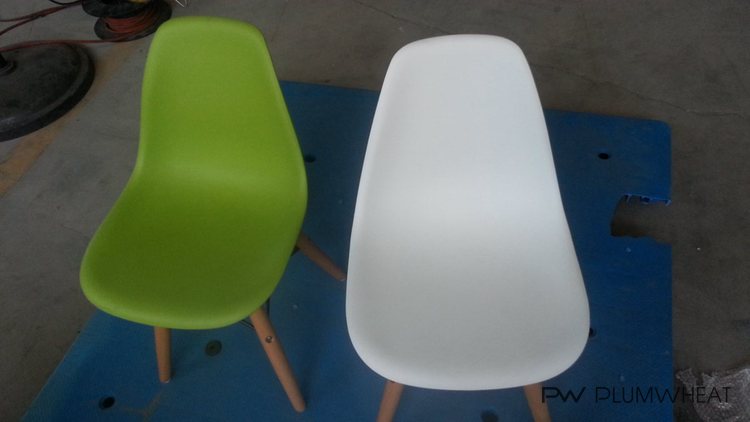
This step was important because two quotations that appear similar on a spreadsheet may refer to products with differences in material, surface finish, stability, hardware or packing. A competitive price was useful only if the corresponding sample was also acceptable.
The Final Order Was Split Between Two Suppliers
After comparing six factories and reviewing the samples, the order was divided between two suppliers.
One supplier was selected for the one-piece moulded models PW885, PW884 and PW855. The other supplier produced the remaining chair styles, including detachable models such as PW801W.
This arrangement created more coordination work than placing the whole order with one factory. Two production schedules had to be followed, and the completed goods had to arrive at the same warehouse in time for inspection and container loading.
That coordination was handled locally so that the buyer did not have to manage two factories, multiple packing methods and a combined shipment from overseas.
Packing Strategy Was Part of the Purchasing Decision
For furniture, product price is only one part of the cost. Packing volume can have a major effect on how many units fit into a container.
The order included both detachable chairs and one-piece moulded chairs, so one packing method could not be used for every model.
PW801W: Seats and Legs Packed Separately
PW801W could be disassembled. To use the available container space more efficiently, its seats and legs were packed separately.
- Five sets of legs were packed in each leg carton.
- Ten seats were packed in each seat carton.
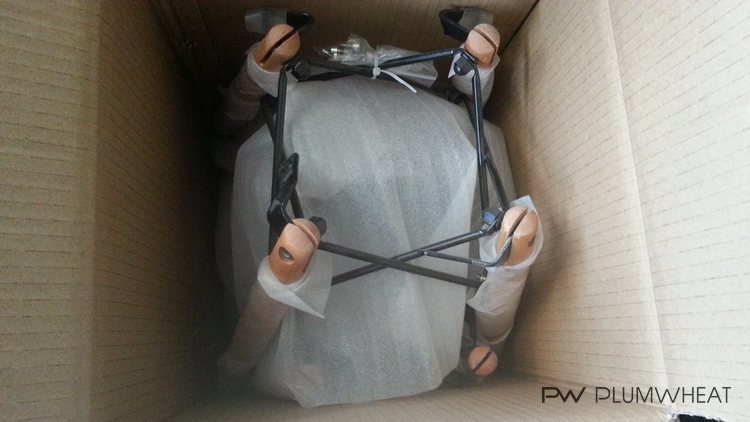
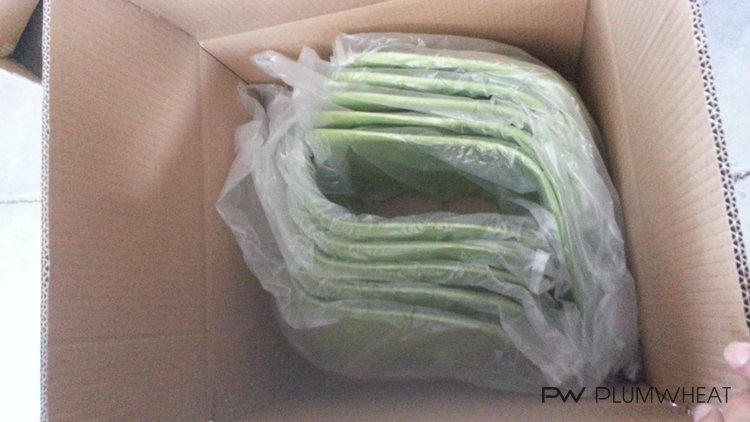
Separating the components allowed the chair shells to be nested more closely and prevented the assembled legs from creating unused space around each chair. Protective material and corner guards were still needed to reduce the risk of rubbing, scratching and impact during handling.
The most compact arrangement is not automatically the safest arrangement. Packing design has to balance carton volume with adequate product protection.
PW884: One-Piece Chairs Packed Four per Carton
PW884 was a one-piece moulded chair and could not be disassembled. Four chairs were nested and packed in each carton.
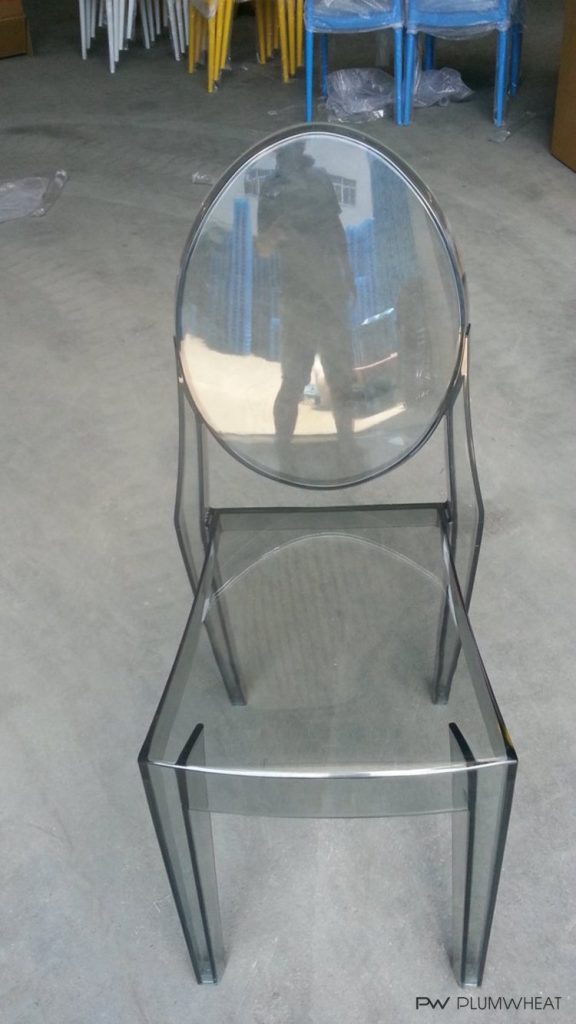
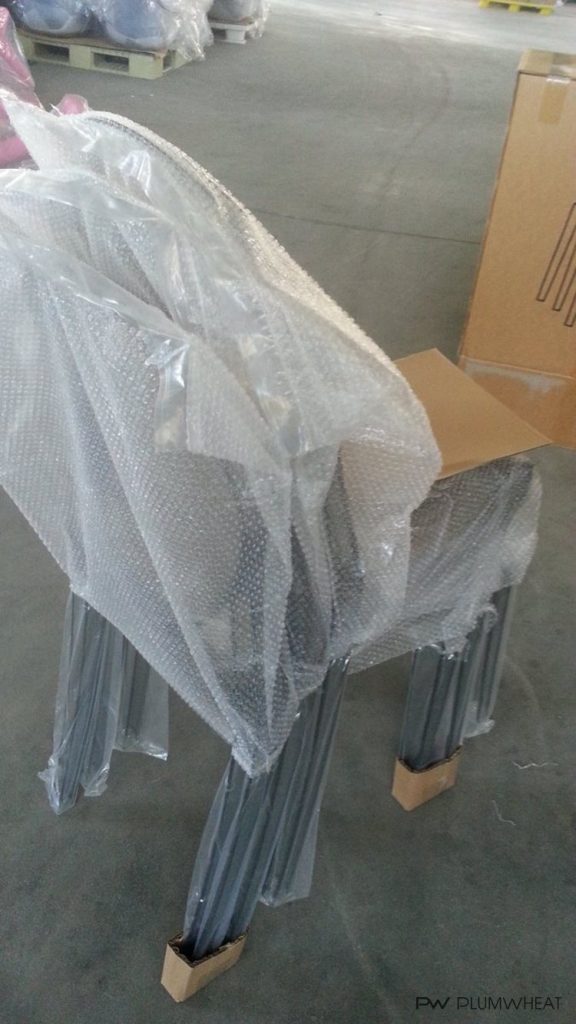
Because the assembled chair had an irregular profile, a conventional rectangular carton would have left additional empty space. A shaped carton was therefore used to follow the stacked form more closely.
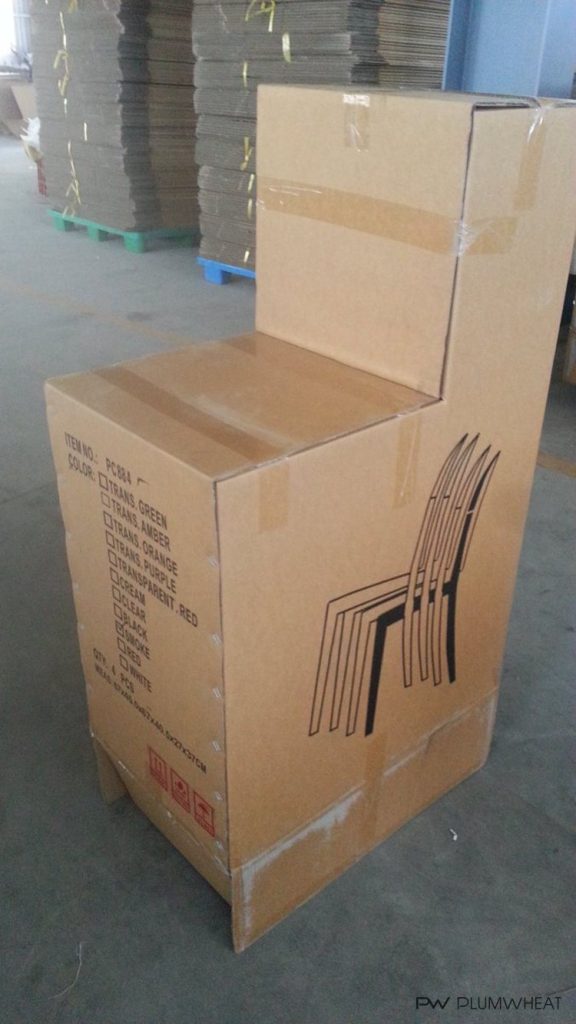
This did not make the chair as compact as a fully detachable model, but it improved the use of carton and container space within the limitations of the one-piece structure.
All Goods Were Consolidated at Our Ningbo Warehouse
After production, both suppliers delivered their goods to our warehouse in Ningbo. This created one location for receiving, checking and loading the complete order.
Warehouse consolidation helped us coordinate:
- arrival timing from both suppliers;
- carton quantities and model assortments;
- visible carton condition;
- inspection against the approved samples;
- shipping marks and packing information;
- the loading sequence for the 40HQ container.
The buyer received one combined shipment instead of arranging separate international shipments from two factories.
Consolidation does not automatically reduce every cost. Domestic transport to the warehouse and handling must also be considered. In this project, however, using two suppliers and one consolidated container formed the selected overall purchasing solution.
Pre-Shipment Inspection Used the Approved Samples as References
Before loading, the goods were inspected to confirm that the supplied chairs were consistent with the approved samples and order requirements.
The agreed checks covered:
- quantities and model assortment;
- chair colours;
- visible scratches and surface condition;
- dimensions;
- stability and wobbling;
- assembly;
- supplied hardware;
- product and carton packing;
- shipping marks.
The checks were relevant to the different chair structures. Detachable chairs required attention to component quantities, hardware and assembly. One-piece transparent or coloured chairs required careful visual checking for scratches and other visible appearance issues.
The goods were then loaded into the 40HQ container at the Ningbo warehouse. The shipment was completed successfully, and the buyer was satisfied with the result.
Why a Purchasing Agent Can Help with a Multi-Supplier Furniture Order
A buyer can contact several factories directly, but the workload increases quickly when one order contains many styles, colours and packing structures.
In this project, local coordination included:
- sending the product list to potential suppliers;
- comparing quotations from six factories;
- arranging and reviewing samples;
- selecting different suppliers for different product groups;
- following two production schedules;
- coordinating delivery to one warehouse;
- checking the finished goods against the samples;
- preparing different packing solutions for detachable and one-piece chairs;
- consolidating 980 chairs into one 40HQ shipment.
The value of the service was not simply finding a factory. It was combining several purchasing tasks into one coordinated order while keeping the buyer’s product and shipment requirements in view.
Information Buyers Should Prepare for a Mixed Chair Order
When requesting quotations for several leisure chair models, buyers should provide as much of the following information as possible:
- product photographs, drawings or reference links;
- required material and surface finish;
- dimensions;
- colours and colour references;
- required quantity for each model and colour;
- whether the chair must be detachable or supplied assembled;
- load, stability or other test requirements;
- preferred packing method;
- carton and shipping-mark requirements;
- destination and expected shipping method;
- approved sample or defect references, if available.
Suppliers should be asked to quote packing information as well as unit price. Carton dimensions, units per carton, gross weight and total volume are necessary when comparing the likely landed cost of different offers.
The Main Lesson from This Project
A supplier capable of producing every item is not always the strongest supplier for every item.
For a multi-model furniture order, the more useful comparison is often made at product-group or model level. Samples then help confirm whether a competitive quotation also provides acceptable quality. Finally, packing and consolidation determine whether the selected sourcing plan works as one shipment.
In this case, six factories were compared, two were selected, and 980 chairs across 20 model-and-colour combinations were consolidated into one 40HQ container. The result came from coordinating supplier selection, sample confirmation, packing design, inspection and loading as one connected process.
Related product: PW818 Upholstered Plastic Dining Chair with Two Wooden Leg Options.
Need Help Sourcing and Consolidating Products in China?
PLUMWHEAT supports international buyers who need help comparing suppliers, arranging samples, following production, inspecting goods and consolidating products from different Chinese factories.
You can ask us to manage the full purchasing process or support only the stages you need.
- Learn more about our China sourcing agent service.
- Learn more about our quality inspection service.